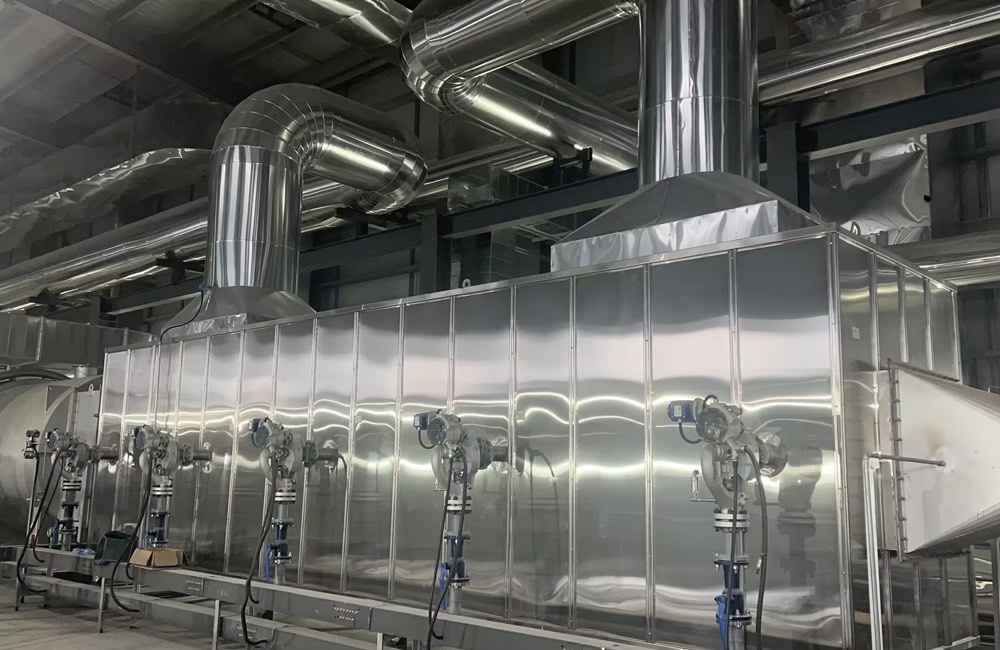
In the manufacturing of carbon fiber, known as "black gold," precisely controlled heat is essential for transforming raw precursor into high-performance fibers. The high-temperature tubular heat exchanger plays an indispensable role as the "thermal heart" of this process, directly impacting the final product quality and production costs.
An Irreplaceable Role: Providing Thermal Energy for Key Processes
The heat exchanger is crucial in two core stages of carbon fiber production:
Pre-oxidation Process: This stage requires uniformly and gently heating the precursor within a specific temperature range for an extended period. The tubular heat exchanger supplies the pre-oxidation furnace with stable, pure, and highly uniform hot air. Its superior temperature control capability is fundamental for ensuring synchronized fiber transformation, preventing defects, and improving yield.
Carbonization Process: This stage occurs under high temperatures and an oxygen-free environment. The heat exchanger heats protective inert gases (like nitrogen) to the required extreme temperatures. It must operate reliably long-term under these harsh conditions while maintaining absolute atmospheric purity inside the furnace, preventing fiber oxidation and enabling the fiber to achieve exceptional mechanical properties.
Core Value for the Carbon Fiber Industry
Ensures Product Quality: By providing unparalleled temperature uniformity and stability, it creates the prerequisite for producing high-performance carbon fiber with excellent consistency.
Enhances Production Efficiency: A stable thermal field significantly reduces production issues like filament breakage and fuzzing, ensuring continuous, high-speed operation and directly increasing output and efficiency.
Achieves Energy Efficiency: Optimized heat exchange design maximizes thermal energy recovery and utilization, substantially reducing operational costs in this energy-intensive industry.
In Summary
The high-temperature tubular heat exchanger has evolved beyond its basic function, becoming core equipment that guarantees high quality, high efficiency, and cost-effectiveness in the carbon fiber industry. Its ongoing technological progress will continue to advance in lockstep with the innovation and development of carbon fiber production.


