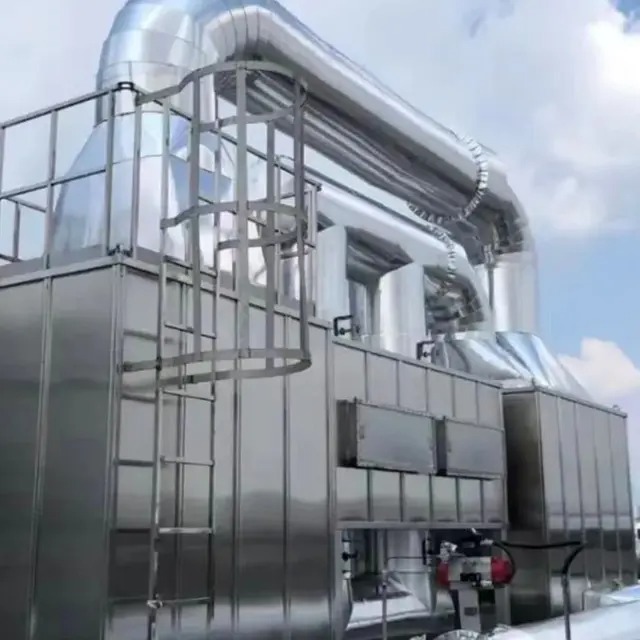
Gas To Gas Platular Heat Exchanger for VOC Exhaust Preheating Before Catalytic Oxidation
A VOC exhaust preheating heat exchanger is a key energy-saving component in catalytic oxidation systems, especially for large-volume, low-concentration, and continuously operated VOC exhaust streams. Instead of relying entirely on a burner or electric heater, the VOC exhaust preheating heat exchanger recovers heat from the hot purified outlet gas and transfers it to the incoming VOC-laden exhaust before it enters the catalytic reactor. A well-designedVOC exhaust preheating heat exchangermust not only improve heat recovery efficiency but also control pressure drop, leakage risk, particulate fouling, moisture condensation, material corrosion, and flue gas dew point corrosion under real industrial operating conditions.
●Moisture, dust, acids, and solvents affect exchanger design.
●Flue gas dew point corrosion must be controlled by temperature and material selection.
Why a VOC Exhaust Preheating Heat Exchanger Is Needed Before Catalytic Oxidation
Catalytic Oxidation Requires Controlled Inlet Temperature
Catalytic oxidation requires the VOC-laden gas to reach a suitable catalyst activation temperature before efficient oxidation can occur. A VOC exhaust preheating heat exchanger raises the inlet gas temperature by recovering heat from the treated outlet gas, reducing the workload of the auxiliary heater. Without stable preheating, the catalytic reactor may experience low-temperature operation, incomplete VOC conversion, or wider outlet emission fluctuation.
Direct Heating Alone Increases Operating Cost
If a catalytic oxidation system has no VOC exhaust preheating heat exchanger, all required temperature rise must be supplied by fuel, electricity, steam, or another external heat source. For high airflow exhaust streams, even a moderate temperature increase can create substantial long-term energy consumption. A VOC exhaust preheating heat exchanger lowers this energy demand by reusing heat that would otherwise be discharged through the stack.
Heat Recovery Improves the System Energy Balance
A catalytic oxidizer outlet gas normally contains valuable residual heat after VOC destruction. A VOC exhaust preheating heat exchanger captures part of this heat and transfers it to the incoming untreated exhaust, improving the thermal balance of the whole VOC treatment line. However, the heat recovery target must be designed carefully because excessive cooling of the clean outlet gas may increase condensation and flue gas dew point corrosion risk.
How a Gas-to-Gas Platular VOC Exhaust Preheating Heat Exchanger Works
Basic Heat Transfer Principle
A gas-to-gas platular VOC exhaust preheating heat exchanger uses welded metal plates to separate the hot clean outlet gas from the cold VOC-laden inlet gas. Heat passes through the metal plate wall while the two gas streams remain physically separated. This arrangement allows energy recovery without allowing untreated VOC exhaust to mix with purified outlet gas.
Counterflow and Crossflow Heat Exchange
Counterflow designs are often selected when the VOC exhaust preheating heat exchanger needs higher thermal efficiency within a compact footprint. Crossflow arrangements may be used when duct layout, installation space, pressure drop, or maintenance access requires a different flow path. In either configuration, the cold-end wall temperature should remain above the critical dew point range to reduce flue gas dew point corrosion.
Welded Platular Construction
A platular VOC exhaust preheating heat exchanger is commonly built with welded plate packs rather than gasketed plates. Welded construction improves resistance to elevated temperature, thermal cycling, and solvent-containing exhaust conditions. Plate thickness, weld quality, channel spacing, expansion design, and drainage arrangement all influence exchanger life and operating reliability.
Component or Parameter
Function in a VOC Exhaust Preheating Heat Exchanger
Engineering Concern
Welded plate pack
Transfers heat between clean gas and VOC exhaust
Heat efficiency, leakage prevention
Flow channels
Guide gas through heat transfer surfaces
Pressure drop, fouling resistance
Cold-end section
Final cooling zone of outlet gas
Condensation and flue gas dew point corrosion
Inspection access
Allows checking and cleaning
Dust, resin, tar, or oil mist accumulation
Drainage design
Removes possible condensate
Corrosion control and safe operation
Benefits of a VOC Exhaust Preheating Heat Exchanger
Lower Auxiliary Fuel or Electric Heating Demand
The primary benefit of a VOC exhaust preheating heat exchanger is reducing the amount of external energy required before catalytic oxidation. When incoming VOC exhaust is already preheated by recovered outlet heat, the burner or electric heater only needs to supply the remaining temperature rise. This is especially valuable in continuous processes where the oxidizer operates for long hours.
More Stable Catalytic Reactor Operation
A VOC exhaust preheating heat exchanger reduces temperature fluctuation at the catalytic reactor inlet. Stable inlet temperature protects the catalyst from repeated thermal shock and supports more consistent VOC destruction efficiency. It also reduces the chance of low-temperature periods that can allow VOC slip through the reactor.
Compact Heat Recovery Layout
A platular VOC exhaust preheating heat exchanger offers high heat transfer density in a compact body. Compared with many conventional gas-to-gas shell-and-tube designs, welded plate construction can reduce the required installation footprint for the same heat recovery duty. Compact equipment layout is useful when the heat exchanger, catalytic reactor, fan, ducting, and controls must be arranged within limited plant space.
Reduced Stack Heat Loss
Without a VOC exhaust preheating heat exchanger, a large portion of useful heat leaves the system through the stack. Recovering this heat reduces thermal waste and improves the overall efficiency of the VOC abatement system. The final outlet temperature still needs a safe margin above dew point conditions to prevent flue gas dew point corrosion in the exchanger outlet, downstream duct, and stack.
Critical Design Factors for a VOC Exhaust Preheating Heat Exchanger
VOC Composition and Concentration
The VOC composition directly affects the required catalytic oxidation temperature and the design of the VOC exhaust preheating heat exchanger. Solvents containing chlorine, sulfur, phosphorus, silicon, or heavy organic compounds may influence catalyst life, material selection, and corrosion potential. When acid-forming components are present, flue gas dew point corrosion must be considered in cold-end temperature control.
Moisture Content and Dew Point Control
Moisture content strongly affects the performance and durability of a VOC exhaust preheating heat exchanger. If the metal surface temperature falls below the water or acid dew point, condensate can form on the heat transfer surface. Acidic condensate can attack plates, weld seams, drains, and outlet sections, creating flue gas dew point corrosion and shortening equipment life.
Particulate Loading and Fouling
VOC exhaust may contain dust, resin particles, tar mist, oil mist, coating residue, or other sticky contaminants. These contaminants can build up inside the VOC exhaust preheating heat exchanger, increasing pressure drop and reducing heat transfer efficiency. Fouling can also create local cold spots where condensation and flue gas dew point corrosion become more severe.
Pressure Drop and Fan Power
A VOC exhaust preheating heat exchanger must be designed with a reasonable balance between heat recovery efficiency and pressure drop. Narrow channels and high velocities may improve heat transfer but can increase fan energy consumption and fouling sensitivity. Excessive pressure drop may reduce exhaust capture performance at the source and increase total system operating cost.
Design Factor
Impact on VOC Exhaust Preheating Heat Exchanger
Recommended Engineering Focus
VOC type
Determines oxidation temperature and corrosion risk
Confirm solvent and byproduct chemistry
Moisture content
Affects dew point and condensation
Maintain safe wall temperature margin
Particulate load
Causes fouling and pressure drop increase
Use filtration or accessible cleaning design
Required preheat temperature
Defines heat transfer area
Balance efficiency and outlet gas temperature
Allowable pressure drop
Influences fan selection
Optimize flow channel geometry
Corrosive components
Affect material life
Select suitable stainless steel or alloy
Platular VOC Exhaust Preheating Heat Exchanger vs. Shell-and-Tube Exchanger
Heat Transfer Efficiency
A platular VOC exhaust preheating heat exchanger usually provides strong turbulence and high heat transfer surface utilization. This allows efficient gas-to-gas heat recovery even when the available temperature difference is limited. Shell-and-tube exchangers can be suitable for certain harsh services, but they may require a larger surface area and larger equipment volume for comparable duty.
Installation Footprint
The welded plate arrangement gives a platular VOC exhaust preheating heat exchanger a compact footprint. This is valuable when the heat recovery section must be integrated close to the catalytic oxidizer and connected with short duct runs. Smaller equipment volume can also reduce support structure, insulation area, and installation complexity.
Cleaning and Maintenance
A VOC exhaust preheating heat exchanger used on dusty or sticky exhaust must include proper maintenance access. Shell-and-tube exchangers may offer easier mechanical cleaning in extremely dirty applications, while platular exchangers require engineered access ports, inspection covers, flushing options, or removable sections. If deposits retain acidic moisture, flue gas dew point corrosion may develop beneath the fouling layer.
Material Selection
Material selection for a VOC exhaust preheating heat exchanger depends on temperature, exhaust composition, dew point, and condensation possibility. Stainless steel may be suitable for many solvent exhaust applications, while more aggressive conditions may require higher-grade corrosion-resistant alloys. The material choice should consider both dry high-temperature operation and wet low-temperature corrosion during startup, shutdown, or low-load operation.
Integration of a VOC Exhaust Preheating Heat Exchanger with a Catalytic Oxidizer
Typical Process Flow
A common system collects VOC-laden exhaust from ovens, coating lines, printing lines, or chemical process vents. The exhaust may pass through filtration or demisting before entering the VOC exhaust preheating heat exchanger, where it absorbs heat from the hot purified gas. After preheating, the exhaust passes through an auxiliary heater if needed and then enters the catalytic oxidation reactor.
Temperature Control and Bypass Design
A VOC exhaust preheating heat exchanger should be integrated with temperature sensors, control valves, and bypass dampers when process conditions fluctuate. If heat recovery is too high, the reactor inlet temperature may rise beyond the desired operating range; if heat recovery is too low, the auxiliary heater must compensate. Bypass control also prevents the clean outlet gas from being cooled into a flue gas dew point corrosion range during startup, shutdown, or low-flow conditions.
Safety and LEL Management
VOC systems must maintain safe operation below defined explosive limits and include appropriate interlocks. A VOC exhaust preheating heat exchanger should not create uncontrolled hot spots, solvent accumulation zones, or stagnant pockets where ignition risk can increase. Temperature monitoring, airflow confirmation, emergency shutdown logic, and drainage design are important parts of safe system integration.
Applications of VOC Exhaust Preheating Heat Exchangers
Coating and Painting Lines
Coating and painting processes often generate large air volumes with low to medium VOC concentrations. A VOC exhaust preheating heat exchanger reduces the energy required to raise this solvent-laden air to catalytic oxidation temperature. Since coatings may contain resins, pigments, and additives, the exchanger design should address fouling, cleaning, and flue gas dew point corrosion.
Printing and Packaging Processes
Printing, laminating, and packaging lines release solvent vapors from drying and curing sections. A VOC exhaust preheating heat exchanger recovers heat from the oxidizer outlet gas and returns it to the incoming solvent exhaust. Moisture, ink components, and solvent decomposition products should be evaluated because they may influence deposits and corrosion risk.
Chemical and Pharmaceutical Exhaust
Chemical and pharmaceutical processes may produce variable VOC streams with changing solvent blends. A VOC exhaust preheating heat exchanger for these applications must tolerate composition changes, cleaning needs, and possible corrosive byproducts. Halogenated or sulfur-containing compounds require closer analysis of flue gas dew point corrosion and material compatibility.
Drying and Curing Ovens
Drying and curing ovens often discharge hot exhaust containing VOCs, moisture, and fine organic aerosols. A VOC exhaust preheating heat exchanger can reduce the heating load before catalytic oxidation and improve system thermal efficiency. If the exhaust contains high humidity or acidic components, dew point management and drainage design become especially important.
How to Select the Right VOC Exhaust Preheating Heat Exchanger
Required Process Data
Correct sizing of a VOC exhaust preheating heat exchanger requires exhaust flow rate, inlet temperature, target preheat temperature, VOC composition, VOC concentration, oxygen content, and operating hours. Moisture content, particulate load, acid gas content, and allowable pressure drop are also essential. Incomplete data can lead to insufficient heat recovery, excessive pressure drop, fouling, or flue gas dew point corrosion.
Heat Recovery Efficiency Target
The heat recovery target of a VOC exhaust preheating heat exchanger should be based on actual operating economics and process limits. Extremely high heat recovery may reduce auxiliary energy consumption but can also cool the outlet gas too close to dew point conditions. A practical design balances preheating temperature, safe outlet temperature, pressure drop, and long-term maintainability.
Structural and Material Configuration
A VOC exhaust preheating heat exchanger may require different plate spacing, plate thickness, alloy selection, and thermal expansion structure depending on the exhaust condition. Clean solvent exhaust allows a more compact channel design, while dusty or sticky exhaust needs wider passages and better access. Corrosive or moisture-rich exhaust may require enhanced material selection, insulation, drainage, and temperature control.
Maintenance Planning
Maintenance planning should be included before the VOC exhaust preheating heat exchanger is fabricated and installed. Inspection ports, cleaning access, pressure drop monitoring, temperature measurement, and drainage points allow better control of fouling and corrosion. Regular inspection is especially important when particulate deposits and flue gas dew point corrosion may occur together.
Conclusion
A VOC exhaust preheating heat exchanger is one of the most important components for reducing energy consumption in catalytic oxidation systems. By recovering heat from the hot purified outlet gas, the VOC exhaust preheating heat exchanger lowers auxiliary heating demand, stabilizes catalytic reactor inlet temperature, reduces stack heat loss, and improves overall thermal efficiency. The final design must account for VOC composition, moisture, particulate loading, pressure drop, temperature control, material selection, maintenance access, and flue gas dew point corrosion. For industrial projects requiring customized VOC exhaust heat recovery and catalytic oxidation integration, Nanjing Prandtl Heat Exchange Equipment Co.,Ltd can provide engineered heat exchanger solutions based on flow rate, temperature, VOC composition, moisture content, particulate loading, and corrosion conditions.
FAQ
What is a VOC exhaust preheating heat exchanger?
A VOC exhaust preheating heat exchanger is a gas-to-gas heat exchanger that transfers heat from purified hot outlet gas to untreated VOC-laden inlet gas before catalytic oxidation. It reduces the amount of auxiliary heating needed to reach catalyst operating temperature. The exchanger must be designed for heat recovery, gas separation, pressure drop, fouling control, and corrosion resistance.
Why is a VOC exhaust preheating heat exchanger used before catalytic oxidation?
A VOC exhaust preheating heat exchanger is used because catalytic oxidation requires the exhaust gas to reach a suitable reaction temperature. Heat recovery reduces the energy needed from burners or electric heaters. It also stabilizes reactor inlet temperature and supports consistent oxidation performance.
Can a VOC exhaust preheating heat exchanger handle dusty exhaust?
A VOC exhaust preheating heat exchanger can handle dusty exhaust if the channel geometry, gas velocity, and cleaning access are properly designed. Heavy dust, tar mist, oil mist, or sticky organic residues may require upstream filtration or demisting. Fouling should be monitored because it increases pressure drop and can create cold spots.